A song for students demonstrating the techniques of articulation covered in the last post and use of the upper ring finger. Find out more on the Santa Fe Flute School website
Tuesday, June 27, 2017
Tuesday, June 20, 2017
The Art of Articulation
Most people, when they are taught how to play the Native American style flute are shown where to put their fingers. Yet even beginning NAF players know to cover the holes on a flute because they see other flute players do this. What can’t be seen is the thing that makes a flute sing, which is a stream of air. Who can see the air? Who can see the wind? Wind is the one thing needed to produce the sound of a flute. Flutes, after all, are wind instruments, not “finger” instruments. How a flute sounds: soft, gentle, harsh, warm, thin, full, or clear, is a product of how a stream of air flows through it. NAF players, unfortunately, are rarely taught about their air stream, their breathing or articulation.
Listen to a NAF using no articulation
These notes are not well articulated causing them to sound sour and unpleasant. Who wants to listen to a moaning flute? Who wants to play a moaning flute?
When properly articulated, the rising and lowering of the pitch goes away, leaving a well defined phrase.
Listen to a NAF using articulation
Click here to read the rest of the article on the Santa Fe Flute School website
Articulation: The creation of clear and distinct sounds. Both in speech and music. In speech, articulation is the creation of clear and distinct words. In music, articulation is the creation of clear and distinct notes. How a note starts, stops and moves to other notes are all parts of musical articulation.In a wind instrument, a stream of air blown into a tube produces vibrations. The frequency of a vibration produces a tone. If the player starts the stream of air in a too soft or hesitant manner, the tone will rise in pitch, like a whine. If the stream of air is stopped in a hesitant manner, the pitch drops down, producing a moaning sound.
Listen to a NAF using no articulation
These notes are not well articulated causing them to sound sour and unpleasant. Who wants to listen to a moaning flute? Who wants to play a moaning flute?
When properly articulated, the rising and lowering of the pitch goes away, leaving a well defined phrase.
Listen to a NAF using articulation
Click here to read the rest of the article on the Santa Fe Flute School website
Learn to Play the Native American Flute
Get One-on-One instruction for articulation and other playing techniques. Learn to play the Native American flute with private lessons from Scott August.

Thursday, June 01, 2017
The Quicker Way to Become a Better NAF Player: What a Teacher Can Do for You
Playing a pentatonic melody on a Native American style flute is actually a bit harder, especially for a beginner. With a NAF you have to think about breathing, squeaking, tuning, and the finger holes are impossible to see.
Have you ever seen a person being shown the black keys on a piano and then told to, "Play from the Heart"? Of course not. That would seem like nonsense. You would expect someone trained that way to play a bunch of disconnected, random sounds. Yet that is exactly the only training most people get on the NAF!
While it is true that anyone can make sounds on a Native American Style Flute, the NAF is still a musical instrument and making music with it is more than just blowing into a mouthpiece and your wiggling fingers. Just like playing the piano is more than playing the black keys on a piano. Making music on a NAF is also about breathing, phrasing, good hand positioning, listening and having a solid playing technique.
Just like someone wanting to start playing the piano will find a teacher, having a qualified teacher for the NAF will help you play your instrument with confidence and comfort. A teacher will help you to develop your skills in a safe, non-judgmental environment, enabling you to reach your full potential as a Native American style flute player. This is true even if you've chosen to play the NAF for simple relaxation. How relaxing is it to squeak, run out of breath, feel like your playing is always the same or be nervous playing for friends or family?
Taking lessons from a teacher, even short term, can also help prevent you from making frustrating mistakes, developing long term bad habits, (that are hard to break) and give you the guidance to move forward when you feel stuck.
One of the most common bad habits is poor hand and finger positioning. The majority of players I encounter have this problem, and they are not even aware of it. People who hold their hand wrong don't feel comfortable with their instrument. They feel hesitant, miss holes and squeak frequently. This leads to frustration, a lack of confidence, and a lower level of enjoyment with their playing. If caught early this can be corrected. If not, it can become a very bad, hard-to-break habit. A good teacher will spot this problem, and help you develop good hand and finger techniques to allow you to play with confidence and increase your speed.
Another problem many NAF players have is not breathing correctly. The NAF is a wind instrument and if the player does not know how to breath properly, they run out of breath in the middle of phases, squeak, play out of tune and their tone can sound "sour". Breathing correctly in order to play a wind instrument is a skill that needs to be developed. Running out of breath is no fun. A teacher can help you with the skill of good breathing.
Maybe you took up the NAF to create songs? Just like composing on a piano, you wouldn't expect someone with no training to sit down at a piano and suddenly create music. The songs you hear every day are produced and created by people who have learned the basics of song creation. The basic concepts are not hard or complex, but if you have no training you will be unsure how to start and, at best, waste time reinventing what others already know. A teacher can show you these simple concepts, helping you create songs from even the smallest musical fragment, and guide you when you feel like you are stuck.
In my teaching I have had many students say to me, "I never knew how that was done", or "I never knew that was possible, until you showed me." And it makes sense. How do you know what you don't know? A good teacher, with a solid background in music, can take you far beyond what holes to cover, enabling you to free the music inside you.
Take control of your playing, a teacher will help!
Scott August offers online lessons via Skype Learn to play the Native American Flute from the comfort of your home.
Thursday, September 08, 2011
Release Date Announced for "The Complete Guide to the Native American Style Flute"
The Complete Guide to the Native American Style Flute is Out Now.
To order your copy go to the The Complete Guide to the Native American Style Flute page on the Cedar Mesa Music website.

© Cedar Mesa Music, BMI. All rights reserved.
To order your copy go to the The Complete Guide to the Native American Style Flute page on the Cedar Mesa Music website.
© Cedar Mesa Music, BMI. All rights reserved.
Tuesday, September 06, 2011
First check to Leonard McGann
I sent the first check to Leonard McGann yesterday from sales of "Lone Crow Song". Other payments are being processed and will be mailed soon, as will future sales. To all who have purchased a copy of "Lone Crow Song" thank you for your wonderful support.
© Cedar Mesa Music, BMI. All rights reserved.
© Cedar Mesa Music, BMI. All rights reserved.
Thursday, August 25, 2011
Lone Crow Flute
A Profile of the flute from Lone Crow Song
Part 1 About Leonard
Part 2 About the Flute
Back in 2005, while I was performing in Phoenix at a flute circle on steroids called "Flute Odyssey", I met, and bought a very interesting flute, from Leonard McGann of Lone Crow flutes.
Leonard had traveled all the way from his home in rural Virginia, located on "Difficult Creek Road", to come to the Odyssey. Quite a journey to say the least. I found him to be a kind, warm person, but with a mischievous sense of humor too.
Since then we have stayed in touch and visited during many flute festivals, sharing insights and a few laughs. Okay, a lot of laughs... The most recent event where Leonard and I got to hang out was at the Musical Echoes festival in Florida last May. It was, as always, a lot of fun.

With Leonard McGann at the Flute Odyssey
Then, earlier this summer I learned, with great sadness, that Leonard is very ill. With few exceptions, NAF makers do not make a lot of money, and the sluggish economy has hit them just as hard has it has hit the rest of us. (Us being NAF fans, not Wall Street bankers.) So in addition to dealing with his declining health, he has a mounting pile of medical bills.
Several flute auctions were started to help Leonard with his medical bills, most notability one put together by Randy and Shelly Stenzel of Feather Ridge flutes.
As a recording artist and performer I obviously didn't make flutes that I could donate to the auctions, but I did have the ability to record a song on one of Leonard's flutes. I decided to use the first one I got from him back at the Odyssey gathering. I chose this flute for a number of reasons. For one thing I can’t pick it up and not be reminded of Leonard, but I also chose it because it has a non standard tuning, and I thought that would suit a song written for Leonard. The tuning gives it a unique, one-of-a-kind, quality and Leonard has a unique, one-of-a-kind, quality too!
The resulting song was “Lone Crow Song”. It is available for sale as an MP3 digital download and 100% of the proceeds from all sales of the song go to Leonard to help him and his family deal with his medical bills.

Lone Crow Song
Since it is a very unusual flute I thought it would be interesting to take a look at it in more detail, and that's what this post is all about.
THE LONE CROW FLUTE
The flute that I used to record Lone Crow Song is a six hole Native American style flute, but with a non standard tuning and fingering. Three different scales can be pulled from this instrument making it a fun flute to play, since it has so many notes available to the player. It also sounds great! Clear and sweet.

The Lone Crow Flute
The main scale on the flute is a pentatonic scale, but is not the standard NAF minor pentatonic scale. It has the same notes of that scale, but starts, and ends, one whole step lower. The bottom note is G above middle C and the notes produced are as follows: G-A-C-D-E-G
A standard NAF minor pentatonic with these notes would start, and end on A, and would be look like this: A-C-D-E-G-A
The fingering for this scale is unlike 99% of most NAFs so there is not, to the best of my knowledge, any finger TAB for it. Therefore, to illustrate the fingerings, I will use Xs and Os. An “X” equals a closed finger hole, while an “O” equals an open hole.
THE MAIN “LONE CROW FLUTE” SCALE
Here is the fingering for the main scale with the notes below:
X X X X X O
X X X X O O
X X X O O O
X X O O O O
X X X X X X
X O O O O O
G A C D E G
Although it might look complex all you do is keep the second hole from the bottom covered at all times while opening all the others in succession, starting from the bottom, to play the scale.
Here is a sound sample of this scale:
Lone Crow Flute: Main Scale by Cedar Mesa Music
This scale is called a 1-2-4-5-6 pentatonic scale. Contrary to what you might have heard about such scales, it is not a pentatonic mode. In the larger musical world there are no pentatonic modes. However, it does share all the same notes as the so~called minor pentatonic scale. As we saw earlier, it just starts on a different note, and thus a different root.
The intervals in the scale are: Root, Maj-2nd, 4th, 5th, Maj-6th, Octave.
Notice how the name of the scale 1-2-4-5-6 describes the intervals that are found in the scale.
It is in this scale that I played and wrote “Lone Crow Song”.
THE MINOR PENTATONIC ON A LONE CROW FLUTE
This flute can also play a standard NAF minor pentatonic scale. However, the root note will not longer be the bottom note of G, but will now be the the note a whole step above, which is the pitch A. When playing this scale the flute is now in the key of A.
Here is a fingering chart for the minor pentatonic scale for this flute. Note that in the simplest version of this scale you do not play (close) the bottom hole. The scale starts on the second note (hole) of the flute. The octave (A2) is produced with the fingering shown but the player also has to over blow.
Here is the fingering for the minor pentatonic on this flute, with the notes below:
X X X X O O
X X X O O X
X X O O O X
X O O O O X
X X X X X X
O O O O O O
A C D E G A2
Here is how this scale sounds:
Lone Crow Flute: Min Pentatonic Scale by Cedar Mesa Music
Just like with the main Lone Crow scale, the 2nd hole remains covered at all times. The bottom note really can be played of course, but the root of the scale is still located on the second hole. The A. Like all NAFs in minor pentatonic the intervals are: Root, Min-3rd, 4th, 5th, Min-7th, Octave.
Technically this scale is called a: 1-3-4-5-7 pentatonic scale.
Normally on a typical NAF you could only play one scale and have it be in tune, much less two. But on this ingenious flute we can play another scale! A diatonic major scale.
THE DIATONIC MAJOR SCALE ON A LONE CROW FLUTE
Not only was Leonard able to build this flute with two different pentatonic scales, but he also got a major diatonic scale out of it as well. The so~called “Do-Re-Mi” scale.
Remember, a diatonic scale has seven notes, not just the five found in a pentatonic scale. And to play the diatonic scale on this flute the root note is moved back down to G, the bottom note.
Here is the fingering for the diatonic scale found on this flute. Once again the octave (G2) is overblown:
X X X X X X O X
X X X X X O X X
X X X X O O O X
X X X O O O O X
X X O X X X X X
X O O O O O O X
G A B C D E F G2
Notice how there are two cross fingerings in this scale. The first one happens between notes A and B, the second between notes E and F.
Lone Crow Flute: Major Scale by Cedar Mesa Music
Obviously this is a very complex flute hidden in the simplicity of the NAF design. It is a lot of fun to play and challenges the performer to go farther than the standard minor pentatonic NAF. It’s a lot like Leonard. If you can get your hands on one you'll really enjoy it.
If you would like to help Leonard McGann you can purchase a digital download MP3 copy of Lone Crow Song from the Cedar Mesa Music website. Remember, all proceeds from this song are being donated by Cedar Mesa Music to Leonard.
To purchase your copy click HERE
You can also send donations and cards to Leonard & Kitty McGann at 2534 Difficult Creek Road, Bedford, VA 24523-4542.
© Cedar Mesa Music, BMI. All rights reserved.
Part 1 About Leonard
Part 2 About the Flute
Back in 2005, while I was performing in Phoenix at a flute circle on steroids called "Flute Odyssey", I met, and bought a very interesting flute, from Leonard McGann of Lone Crow flutes.
Leonard had traveled all the way from his home in rural Virginia, located on "Difficult Creek Road", to come to the Odyssey. Quite a journey to say the least. I found him to be a kind, warm person, but with a mischievous sense of humor too.
Since then we have stayed in touch and visited during many flute festivals, sharing insights and a few laughs. Okay, a lot of laughs... The most recent event where Leonard and I got to hang out was at the Musical Echoes festival in Florida last May. It was, as always, a lot of fun.
With Leonard McGann at the Flute Odyssey
Then, earlier this summer I learned, with great sadness, that Leonard is very ill. With few exceptions, NAF makers do not make a lot of money, and the sluggish economy has hit them just as hard has it has hit the rest of us. (Us being NAF fans, not Wall Street bankers.) So in addition to dealing with his declining health, he has a mounting pile of medical bills.
Several flute auctions were started to help Leonard with his medical bills, most notability one put together by Randy and Shelly Stenzel of Feather Ridge flutes.
As a recording artist and performer I obviously didn't make flutes that I could donate to the auctions, but I did have the ability to record a song on one of Leonard's flutes. I decided to use the first one I got from him back at the Odyssey gathering. I chose this flute for a number of reasons. For one thing I can’t pick it up and not be reminded of Leonard, but I also chose it because it has a non standard tuning, and I thought that would suit a song written for Leonard. The tuning gives it a unique, one-of-a-kind, quality and Leonard has a unique, one-of-a-kind, quality too!
The resulting song was “Lone Crow Song”. It is available for sale as an MP3 digital download and 100% of the proceeds from all sales of the song go to Leonard to help him and his family deal with his medical bills.
Lone Crow Song
Since it is a very unusual flute I thought it would be interesting to take a look at it in more detail, and that's what this post is all about.
THE LONE CROW FLUTE
The flute that I used to record Lone Crow Song is a six hole Native American style flute, but with a non standard tuning and fingering. Three different scales can be pulled from this instrument making it a fun flute to play, since it has so many notes available to the player. It also sounds great! Clear and sweet.
The Lone Crow Flute
The main scale on the flute is a pentatonic scale, but is not the standard NAF minor pentatonic scale. It has the same notes of that scale, but starts, and ends, one whole step lower. The bottom note is G above middle C and the notes produced are as follows: G-A-C-D-E-G
A standard NAF minor pentatonic with these notes would start, and end on A, and would be look like this: A-C-D-E-G-A
The fingering for this scale is unlike 99% of most NAFs so there is not, to the best of my knowledge, any finger TAB for it. Therefore, to illustrate the fingerings, I will use Xs and Os. An “X” equals a closed finger hole, while an “O” equals an open hole.
THE MAIN “LONE CROW FLUTE” SCALE
Here is the fingering for the main scale with the notes below:
X X X X X O
X X X X O O
X X X O O O
X X O O O O
X X X X X X
X O O O O O
G A C D E G
Although it might look complex all you do is keep the second hole from the bottom covered at all times while opening all the others in succession, starting from the bottom, to play the scale.
Here is a sound sample of this scale:
Lone Crow Flute: Main Scale by Cedar Mesa Music
This scale is called a 1-2-4-5-6 pentatonic scale. Contrary to what you might have heard about such scales, it is not a pentatonic mode. In the larger musical world there are no pentatonic modes. However, it does share all the same notes as the so~called minor pentatonic scale. As we saw earlier, it just starts on a different note, and thus a different root.
The intervals in the scale are: Root, Maj-2nd, 4th, 5th, Maj-6th, Octave.
Notice how the name of the scale 1-2-4-5-6 describes the intervals that are found in the scale.
It is in this scale that I played and wrote “Lone Crow Song”.
THE MINOR PENTATONIC ON A LONE CROW FLUTE
This flute can also play a standard NAF minor pentatonic scale. However, the root note will not longer be the bottom note of G, but will now be the the note a whole step above, which is the pitch A. When playing this scale the flute is now in the key of A.
Here is a fingering chart for the minor pentatonic scale for this flute. Note that in the simplest version of this scale you do not play (close) the bottom hole. The scale starts on the second note (hole) of the flute. The octave (A2) is produced with the fingering shown but the player also has to over blow.
Here is the fingering for the minor pentatonic on this flute, with the notes below:
X X X X O O
X X X O O X
X X O O O X
X O O O O X
X X X X X X
O O O O O O
A C D E G A2
Here is how this scale sounds:
Lone Crow Flute: Min Pentatonic Scale by Cedar Mesa Music
Just like with the main Lone Crow scale, the 2nd hole remains covered at all times. The bottom note really can be played of course, but the root of the scale is still located on the second hole. The A. Like all NAFs in minor pentatonic the intervals are: Root, Min-3rd, 4th, 5th, Min-7th, Octave.
Technically this scale is called a: 1-3-4-5-7 pentatonic scale.
Normally on a typical NAF you could only play one scale and have it be in tune, much less two. But on this ingenious flute we can play another scale! A diatonic major scale.
THE DIATONIC MAJOR SCALE ON A LONE CROW FLUTE
Not only was Leonard able to build this flute with two different pentatonic scales, but he also got a major diatonic scale out of it as well. The so~called “Do-Re-Mi” scale.
Remember, a diatonic scale has seven notes, not just the five found in a pentatonic scale. And to play the diatonic scale on this flute the root note is moved back down to G, the bottom note.
Here is the fingering for the diatonic scale found on this flute. Once again the octave (G2) is overblown:
X X X X X O X X
X X X X O O O X
X X X O O O O X
X X O X X X X X
X O O O O O O X
G A B C D E F G2
Notice how there are two cross fingerings in this scale. The first one happens between notes A and B, the second between notes E and F.
Lone Crow Flute: Major Scale by Cedar Mesa Music
Obviously this is a very complex flute hidden in the simplicity of the NAF design. It is a lot of fun to play and challenges the performer to go farther than the standard minor pentatonic NAF. It’s a lot like Leonard. If you can get your hands on one you'll really enjoy it.
If you would like to help Leonard McGann you can purchase a digital download MP3 copy of Lone Crow Song from the Cedar Mesa Music website. Remember, all proceeds from this song are being donated by Cedar Mesa Music to Leonard.
To purchase your copy click HERE
You can also send donations and cards to Leonard & Kitty McGann at 2534 Difficult Creek Road, Bedford, VA 24523-4542.
© Cedar Mesa Music, BMI. All rights reserved.
Tuesday, July 05, 2011
Playing NAF Duets
As always, in deciding what to post to this blog I try to be aware of topics and techniques that people are asking about. One of the topics that I've been asked about a lot lately is “What keys go together well to play duets with my Native American style flute?”
Rather than go through every possible pairing of keys there are a couple very simple ways to figure this out no matter what key your flutes are in.
What keys work best
If you want to play duets, trios, or even quartets, with other flute players the keys of all the flutes need to be related somehow. Keys that are related keys share more notes than unrelated keys and therefore will sound better.
When choosing flutes to play duets with the first step is to pick one NAF as the master, thereby establishing the master key from which to choose other flutes. Once you’ve done this the rest becomes fairly easy. For this post I will also call the master flute: Flute-#1.
In general, to avoid playing too much cross fingering, there are three keys that work the best when picking one to harmonize with Flute #1: The same key, the key a fifth above the master flute, and/or the key a fourth above the master flute.
While this may sound hard, it’s not. Let's start with two flutes a 5th apart.
Finding NAFs a 5th apart
Once you have picked a flute to be Flute-#1, your master flute, you need to figure out what pitch a 5th on that flute is. If you don't know the note names in that key, here's an easy way to locate that pitch you're looking for.
This is the pitch your second flute should play on its bottom note. In other words the bottom note of Flute-#2 plays a pitch a 5th higher than the bottom note on Flute-#1.
This only refers to this one pitch. We will look at how the the scales mesh later in this post.
Here are some common NAF keys that are a 5th apart:
F# - C#, G - D, A - E.
All of these pairs can be in any register. So if you don’t have a high E but do have a mid range E, or even a Bass E it will still work with a flute in the key of A. However, as a general principle, having the flute that is in your master key (Flute-#1) play in a lower register will sound better if you’ve never done this before.
Why This Sounds Good: 5ths
The reason why flutes sound good in these pairing is due to the amount of notes they share. For example flutes that are a 5th apart share all but one note
Out of the six notes available in each NAF's basic scale, four of them can be played by both flutes without any cross fingering.
If we include the note, as shown fingered below, on the second NAF (the one a 5th higher) we can now play the minor 3rd from the master flute on the higher flute. In the example above this would be the Bb flat from the master flute in G, but played on the flute in D. So now we can play that pitch on both flutes! (This is the minor 6th on the flute a 5th higher, but you don't need to know this for it to work.)

Added note on the Flute-#2
Now both flutes can play five of the six total notes available between the two flute's basic scales.
Here's a sample of two NAFs a 5th apart
NAF Duet in 5ths by Cedar Mesa Music
To find out more about all the audio samples in this post be sure to read About the audio samples located at the bottom.
Finding NAFs a 4th apart
Now let's locate the note a 4th above the root of Flute-#1.
Here are some common NAF keys that are a 4th apart: F# - B, G - C, A - D.
Why This Sounds Good: 4ths
Just like NAFs that are a 5th apart, NAFs whose keys are a 4th apart share a lot of notes. Out of 7 total pitches the two flutes share 5 of them. If you use all the notes between both flutes you can play a full diatonic natural minor scale starting on the root of Flute-#2, starting on a C.
When I play duets a 4th apart and am playing Flute-#2 I tend to not play the minor 3rd (the second note on a NAF) but just skip over it. I also like to add the major 6th, for a little spice, which you can get with this fingering

Added note on the flute #2
NAF Duet 4ths by Cedar Mesa Music
"Say What..."
Now let's get a bit clever. If you take a close look at the diagram that compares notes in the key of G and the key of C you might have already figured out that if two players decide that they would rather make the bottom note of Flute-#2 the tonic of the key they are playing in that will make the relationship between the two flutes a 5th.
How does this work, you may be asking? Scales in western music are not divided evenly in half. The bottom half of the scale is the interval of a 5th, while the top half is a 4th.
Therefore, if you and another NAF player decide to play flutes a 5th apart, but the flute used for Flute-#2 is lower than Flute-#1 you could say you are playing a 4th apart! What will determine whether the relationship between the two flutes is a 4th or a 5th is which note is functioning as the root for both flutes. In both of the audio samples in this post the lower flute, Flute-#1, has always played the master root note for both flutes. Therefore the higher flute, Flute-#2, has had to conform to the lower flute's key in each example.
Let's look at this another way. If the notes F# - B are a 4th apart, when you reverse them, B - F# they are now a 5th apart. Conversely if the notes F# - C# are a 5th apart, when you reverse them to C# - F# they are now a 4th apart.
About the Audio Samples
The audio samples were recorded with a Heartsongs flute in the key of D for Flute-#1. One track was used for both samples, e.g. they are the same recording. Above this are a Yazzie flute in A for the sample of two flutes a 5th apart and another Heartsongs flute in G for the sample of the flutes a 4th apart.
I chose to make the master flute, Flute-#1, in D to keep both the second flutes from being too high.


The Three Flutes
© Cedar Mesa Music, BMI. All rights reserved.
Rather than go through every possible pairing of keys there are a couple very simple ways to figure this out no matter what key your flutes are in.
What keys work best
If you want to play duets, trios, or even quartets, with other flute players the keys of all the flutes need to be related somehow. Keys that are related keys share more notes than unrelated keys and therefore will sound better.
When choosing flutes to play duets with the first step is to pick one NAF as the master, thereby establishing the master key from which to choose other flutes. Once you’ve done this the rest becomes fairly easy. For this post I will also call the master flute: Flute-#1.
In general, to avoid playing too much cross fingering, there are three keys that work the best when picking one to harmonize with Flute #1: The same key, the key a fifth above the master flute, and/or the key a fourth above the master flute.
While this may sound hard, it’s not. Let's start with two flutes a 5th apart.
Finding NAFs a 5th apart
Once you have picked a flute to be Flute-#1, your master flute, you need to figure out what pitch a 5th on that flute is. If you don't know the note names in that key, here's an easy way to locate that pitch you're looking for.
| The root of your master flute (Flute-#1) no matter what key you choose, will be fingered like this: |  |
| To find the 5th on the master flute play this fingering: |  |
| To look at it another way, the pitch produced by playing this fingering on the master key flute... | |
| ...will be the same pitch as produced by this fingering on a NAF a 5th higher. | |
|---|
This only refers to this one pitch. We will look at how the the scales mesh later in this post.
Here are some common NAF keys that are a 5th apart:
F# - C#, G - D, A - E.
All of these pairs can be in any register. So if you don’t have a high E but do have a mid range E, or even a Bass E it will still work with a flute in the key of A. However, as a general principle, having the flute that is in your master key (Flute-#1) play in a lower register will sound better if you’ve never done this before.
Why This Sounds Good: 5ths
The reason why flutes sound good in these pairing is due to the amount of notes they share. For example flutes that are a 5th apart share all but one note
| Key=G | G | Bb | C | D | F | G | - | - | - |
|---|---|---|---|---|---|---|---|---|---|
| Key=D | - | - | - | D | F | G | A | C | D |
Out of the six notes available in each NAF's basic scale, four of them can be played by both flutes without any cross fingering.
If we include the note, as shown fingered below, on the second NAF (the one a 5th higher) we can now play the minor 3rd from the master flute on the higher flute. In the example above this would be the Bb flat from the master flute in G, but played on the flute in D. So now we can play that pitch on both flutes! (This is the minor 6th on the flute a 5th higher, but you don't need to know this for it to work.)
Added note on the Flute-#2
Now both flutes can play five of the six total notes available between the two flute's basic scales.
Here's a sample of two NAFs a 5th apart
NAF Duet in 5ths by Cedar Mesa Music
To find out more about all the audio samples in this post be sure to read About the audio samples located at the bottom.
Finding NAFs a 4th apart
Now let's locate the note a 4th above the root of Flute-#1.
| Playing this fingering on your master flute... |  |
| ...will produce the same pitch as the root note on a flute a 4th higher | |
Here are some common NAF keys that are a 4th apart: F# - B, G - C, A - D.
Why This Sounds Good: 4ths
Just like NAFs that are a 5th apart, NAFs whose keys are a 4th apart share a lot of notes. Out of 7 total pitches the two flutes share 5 of them. If you use all the notes between both flutes you can play a full diatonic natural minor scale starting on the root of Flute-#2, starting on a C.
| Key=G | G | Bb | C | D | - | F | G | - | - |
|---|---|---|---|---|---|---|---|---|---|
| Key=C | - | - | C | - | Eb | F | G | Bb | C |
When I play duets a 4th apart and am playing Flute-#2 I tend to not play the minor 3rd (the second note on a NAF) but just skip over it. I also like to add the major 6th, for a little spice, which you can get with this fingering
Added note on the flute #2
NAF Duet 4ths by Cedar Mesa Music
"Say What..."
Now let's get a bit clever. If you take a close look at the diagram that compares notes in the key of G and the key of C you might have already figured out that if two players decide that they would rather make the bottom note of Flute-#2 the tonic of the key they are playing in that will make the relationship between the two flutes a 5th.
How does this work, you may be asking? Scales in western music are not divided evenly in half. The bottom half of the scale is the interval of a 5th, while the top half is a 4th.
Therefore, if you and another NAF player decide to play flutes a 5th apart, but the flute used for Flute-#2 is lower than Flute-#1 you could say you are playing a 4th apart! What will determine whether the relationship between the two flutes is a 4th or a 5th is which note is functioning as the root for both flutes. In both of the audio samples in this post the lower flute, Flute-#1, has always played the master root note for both flutes. Therefore the higher flute, Flute-#2, has had to conform to the lower flute's key in each example.
Let's look at this another way. If the notes F# - B are a 4th apart, when you reverse them, B - F# they are now a 5th apart. Conversely if the notes F# - C# are a 5th apart, when you reverse them to C# - F# they are now a 4th apart.
About the Audio Samples
The audio samples were recorded with a Heartsongs flute in the key of D for Flute-#1. One track was used for both samples, e.g. they are the same recording. Above this are a Yazzie flute in A for the sample of two flutes a 5th apart and another Heartsongs flute in G for the sample of the flutes a 4th apart.
I chose to make the master flute, Flute-#1, in D to keep both the second flutes from being too high.
The Three Flutes
© Cedar Mesa Music, BMI. All rights reserved.
Tuesday, June 07, 2011
Cedar Mesa Music Digital Store Open!
The NEW Digital Store is open on CedarMesa.com.
Now you can purchase high quality MP3 files of Scott August's recordings directly from his website!
Click the image below to get started

Why would you give your money to Steve Jobs & Apple (or Amazon) when you can buy direct from the artist?
Now you can purchase high quality MP3 files of Scott August's recordings directly from his website!
Why would you give your money to Steve Jobs & Apple (or Amazon) when you can buy direct from the artist?
Thursday, April 14, 2011
Two Festivals and a School
Things are gearing up for a busy May in the Native Flute world. The Musical Echoes festival and Zion flute festivals are coming up as is the Zion flute school.
If you are planning to attend any of these events I am available for private lessons on Native American style flutes (all levels) and Anasazi, Mojave and other end-blown flutes. Some people have already contacted me to set up lessons so my schedule is starting to book up. If you are interested in a private lesson please contact me as soon as you can to set one up. Space is limited.
I will also be performing at both festivals and teaching the Anasazi style flute workshop at the Zion flute school. Here are the dates for these events:
Musical Echoes Flute Festival
April 29 - 30, May 1, 2011
Ft. Walton Landing, Ft. Walton Beach, FL
musicalechoes.org
Zion Canyon Native Flute School
May 8 - 12, 2011
PO Box 362, Springdale, UT 84767
( 435 ) 772 - 0778
zioncanyonnativefluteschool.com
Zion Flute Festival
May 12 - 14, 2011
Springdale, UT 84767
zionflutefestivalcom
Even if you can't make it to any of these events you can always get a lesson online. All levels are welcome. There is no minimum number of lessons needed. You can take just one, do one a week, or anything in between. You don't even have to live in the United States. (Two of my student don't) Find out more
If you are planning to attend any of these events I am available for private lessons on Native American style flutes (all levels) and Anasazi, Mojave and other end-blown flutes. Some people have already contacted me to set up lessons so my schedule is starting to book up. If you are interested in a private lesson please contact me as soon as you can to set one up. Space is limited.
I will also be performing at both festivals and teaching the Anasazi style flute workshop at the Zion flute school. Here are the dates for these events:
Musical Echoes Flute Festival
April 29 - 30, May 1, 2011
Ft. Walton Landing, Ft. Walton Beach, FL
musicalechoes.org
Zion Canyon Native Flute School
May 8 - 12, 2011
PO Box 362, Springdale, UT 84767
( 435 ) 772 - 0778
zioncanyonnativefluteschool.com
Zion Flute Festival
May 12 - 14, 2011
Springdale, UT 84767
zionflutefestivalcom
Even if you can't make it to any of these events you can always get a lesson online. All levels are welcome. There is no minimum number of lessons needed. You can take just one, do one a week, or anything in between. You don't even have to live in the United States. (Two of my student don't) Find out more
Saturday, March 05, 2011
Shadows of Sedona / Quiet Journey
A new video set to my song "Quiet Journey" for Anasazi flute, featuring time lapse video of Sedona, AZ.
Buy this song Here
Buy this song Here
Sunday, February 13, 2011
Radiant Sky nominated for Best Album of the Year
Congratulations
to Scott August!
from Cedar Mesa Music

Radiant Sky
Nominated for two ZMR Awards!
Best Album of the Year &
Best Native New Age Album
Read more
from Cedar Mesa Music
Radiant Sky
Nominated for two ZMR Awards!
Best Album of the Year &
Best Native New Age Album
Read more
Saturday, February 12, 2011
NAF Major Scale Fingering
In all of the previous articles about scales we've delved a little bit into how major diatonic scales are constructed but not how to play them.
Some of my students asked me recently about how a major scale would be fingered so I thought I'd make this available to everyone.
The first thing to remember is that the basic scale on a NAF is a 5-note, or pentatonic 1-3-4-5-7 scale. The so-called "Minor Pentatonic". Although for most of you this is common knowledge, it's worth pointing it out since any full diatonic (7-note) major scale will have to have crossed fingering.
 THE MINOR PENTATONIC SCALE
Very quickly let's review the NAF Minor Pentatonic scale. As most of you know, this is pretty easy to play. Starting with all the holes covered you lift one finger at a time beginning with the bottom finger, working your way up the flute, but never lifting the 4th hole from the bottom. In this scale it always stays covered.
A 6-NOTE MAJOR SCALE
If we want to play a Major scale starting on the root note of the flute (all holes covered) we can only get a partial 6-note major scale.
Read the full article and see the finger charts
The first thing to remember is that the basic scale on a NAF is a 5-note, or pentatonic 1-3-4-5-7 scale. The so-called "Minor Pentatonic". Although for most of you this is common knowledge, it's worth pointing it out since any full diatonic (7-note) major scale will have to have crossed fingering.
THE MINOR PENTATONIC SCALEVery quickly let's review the NAF Minor Pentatonic scale.
As most of you know, this is pretty easy to play. Starting with all the holes covered you lift one finger at a time beginning with the bottom finger, working your way up the flute, but never lifting the 4th hole from the bottom. In this scale it always stays covered.
A 6-NOTE MAJOR SCALEIf we want to play a Major scale starting on the root note of the flute (all holes covered) we can only get a partial 6-note major scale.
Read the full article and see the finger charts
Wednesday, August 25, 2010
Flute Quest festival 2010
I just got back from Flute Quest and thought I'd talk a little about my experience at the festival. Sorry I don't have any photos. There are some in the forum from the event. I'll put a link at the end of this post.
I flew into Sea-Tac airport last Thursday, August 19th after a two hour flight from LAX. Ironically from the side of the jet that I was on I could see Yosemite National Park, near where the Yosemite Flute Festival will be happening next month. We also flew over Lake Tahoe, Crater Lake, Mt. Hood, Mt Saint Helens and the ginormous Mt. Rainier, which poked it's cone above the clouds that obscured the ground below. At the last moment as we descended toward the airport we broke through the cloud cover and there below us was downtown Seattle, the Space Needle, the waterfront and beautiful Puget Sound.
Waiting for me as I approached the luggage carousel was Chris and Carole. Two volunteers that had the task of driving me around. (I am not using last names to protect the innocent.) They helped me get my bag and then took me out to a nice lunch of fish and chips at a restaurant on the water in the town of Des Monies. Then it was off to see the festival's day ground in Saltwater State Park.
The Site
Saltwater State Park lies in a tiny canyon created by the McSorley creek. This made the area nice and tucked away from the rest of the world. The steep hillsides that lined the valley were tree covered and the valley itself emptied into Puget Sound at a lovely sand covered beach lined with cool sun bleached driftwood logs. Just a few yards inland from this was the park. A nice grassy park with big shade trees, now lined with the white booths of vendors. There was Butch and Laura Hall, Nash, Tom Steward, Michael Graham Allen, Brent Haines, Rick and Linda of Vision Hawk with their two new puppies Chaco and Pecos and many more. In fact there were so great vendors I never made it to all their booths when I had the time between workshops. Finally, there were some great food vendors. Los Agaves had really authentic taco and other Mexican food and the doughnut vendors whose fresh little doughnuts I'll be thinking about for a while!
Set in one corner was a very nice, large stage for day performers. The whole festival was laid out well. It was big but intimate at the same time. As a cornerstone to the event was the WA Flute Circle booth, the hosts and facilitator of Flute Quest. I got a chance to say Hi to Lisa, who was my point person for the event and did so much of the publicity and arrangements for the festival. I also met many of the volunteers who's hard work and dedication was making this all possible. Later that night everyone there was invited to a get together of food, including some great chicken and salmon. Then it was off to the hotel to rest before the first day.
Day 1
The first day of the festival was nice and cool. A perfect break from the heat of LA. Up first for me was a workshop on the Anasazi flute. I had at least 10 people attending and they all did great! Everyone, from the more experienced to the beginner, got a tone. We went over ways to help get a sound, exercises to improve one's tone and looked at three of this flute scales. I felt everyone did very well and hope they all keep playing, especially those that had less experience. After the workshop I gave a couple private lessons right by the water. It was really one of the most picturesque setting I've ever given a lesson in. Not unlike Musical Echoes, with the water right there.
Before I knew it, it was time to get to the Knutzen Family Theatre where the evening concerts were to be. There I meet Laura, Steve, Amy and Bret who helped myself and Rona Yellow Robe set up and get our "act" together. The venue was really nice. It held 250 persons but was still very intimate in it's layout. The seats come right down to the stage. Both Rona and myself had video presentations for our respective sets and the screen was very big, while the lighting could still be put on both of us during our performances. Most venues only have a strip of lights and either I'm in the dark or the screen is washed out. So this was a welcome perk.
There was a great audience that night. Very enthusiastic and warm. I had a great time during my performance and with the great feedback coming from the crowd I really got into the music. I don't know if anyone got photos of my performance, but if they did I'd love to see them.
Day 2
The second day I had the first of a two part Songwriting/Improvisation workshop. We began by talking about one of the more common ways to quickly come up with a tune by using building blocks derived from the very first notes that come out of your flute. We also discussed how to balance new musical thoughts with repeated ones and some of the basic shapes that a melody can take. I enjoy giving this workshop as a lot of people think that writing a song for their flute is a big giant challenge. But it's really not if you know how to break it down into small components.
After the workshop I gave a couple lessons and sat at the table where the artists could sell their stuff. That gave me the chance to meet some people and talk a little with them.
That night was Joe Young and Mary Youngblood's performances.
Day 3
The last day had a little drizzle in the morning but the sun broke through by the middle of the day. For me it was part two of my Songwriting/Improvisation workshop. We continued where we left off and expanded the small melody that we looked at the day before into a full, short tune for NAF. We also talked a little about rhythm and tempo, and more ways to easily grow ideas into full songs. All the while I was illustrating the concepts on a white board, which, as is normally the case, became a big messy doodle. Some mention was also made about northern Kokopellis vs. southern ones but we won't talk about that here...
Seattle
When the festival ended at 3 pm Joe, his wife LaRee, Ken, our friend Sharon, (who was kind enough to help me sell my CDs during my performance) and myself went off to Seattle to visit Pike Place Market, the Experience Music Project and the Space Needle. We had a great time even though Lark in the Morning has closed the store in Pike's Place. I also wanted to visit the original Starbucks store too. A pilgrimage for my caffeine habit. There were a lot of very talented and unusual musicians playing throughout the market. The Experience Music Project was interesting especially if you're into electric guitar. There is also a Sci-Fi museum in the building too. The big bummer, for me anyway, was that the Space Needle was closed for a private event! Maybe next trip.

I posted a few photos on flicker
Here are the photos from others in a forum on the portal
© Cedar Mesa Music
I flew into Sea-Tac airport last Thursday, August 19th after a two hour flight from LAX. Ironically from the side of the jet that I was on I could see Yosemite National Park, near where the Yosemite Flute Festival will be happening next month. We also flew over Lake Tahoe, Crater Lake, Mt. Hood, Mt Saint Helens and the ginormous Mt. Rainier, which poked it's cone above the clouds that obscured the ground below. At the last moment as we descended toward the airport we broke through the cloud cover and there below us was downtown Seattle, the Space Needle, the waterfront and beautiful Puget Sound.
Waiting for me as I approached the luggage carousel was Chris and Carole. Two volunteers that had the task of driving me around. (I am not using last names to protect the innocent.) They helped me get my bag and then took me out to a nice lunch of fish and chips at a restaurant on the water in the town of Des Monies. Then it was off to see the festival's day ground in Saltwater State Park.
The Site
Saltwater State Park lies in a tiny canyon created by the McSorley creek. This made the area nice and tucked away from the rest of the world. The steep hillsides that lined the valley were tree covered and the valley itself emptied into Puget Sound at a lovely sand covered beach lined with cool sun bleached driftwood logs. Just a few yards inland from this was the park. A nice grassy park with big shade trees, now lined with the white booths of vendors. There was Butch and Laura Hall, Nash, Tom Steward, Michael Graham Allen, Brent Haines, Rick and Linda of Vision Hawk with their two new puppies Chaco and Pecos and many more. In fact there were so great vendors I never made it to all their booths when I had the time between workshops. Finally, there were some great food vendors. Los Agaves had really authentic taco and other Mexican food and the doughnut vendors whose fresh little doughnuts I'll be thinking about for a while!
Set in one corner was a very nice, large stage for day performers. The whole festival was laid out well. It was big but intimate at the same time. As a cornerstone to the event was the WA Flute Circle booth, the hosts and facilitator of Flute Quest. I got a chance to say Hi to Lisa, who was my point person for the event and did so much of the publicity and arrangements for the festival. I also met many of the volunteers who's hard work and dedication was making this all possible. Later that night everyone there was invited to a get together of food, including some great chicken and salmon. Then it was off to the hotel to rest before the first day.
Day 1
The first day of the festival was nice and cool. A perfect break from the heat of LA. Up first for me was a workshop on the Anasazi flute. I had at least 10 people attending and they all did great! Everyone, from the more experienced to the beginner, got a tone. We went over ways to help get a sound, exercises to improve one's tone and looked at three of this flute scales. I felt everyone did very well and hope they all keep playing, especially those that had less experience. After the workshop I gave a couple private lessons right by the water. It was really one of the most picturesque setting I've ever given a lesson in. Not unlike Musical Echoes, with the water right there.
Before I knew it, it was time to get to the Knutzen Family Theatre where the evening concerts were to be. There I meet Laura, Steve, Amy and Bret who helped myself and Rona Yellow Robe set up and get our "act" together. The venue was really nice. It held 250 persons but was still very intimate in it's layout. The seats come right down to the stage. Both Rona and myself had video presentations for our respective sets and the screen was very big, while the lighting could still be put on both of us during our performances. Most venues only have a strip of lights and either I'm in the dark or the screen is washed out. So this was a welcome perk.
There was a great audience that night. Very enthusiastic and warm. I had a great time during my performance and with the great feedback coming from the crowd I really got into the music. I don't know if anyone got photos of my performance, but if they did I'd love to see them.
Day 2
The second day I had the first of a two part Songwriting/Improvisation workshop. We began by talking about one of the more common ways to quickly come up with a tune by using building blocks derived from the very first notes that come out of your flute. We also discussed how to balance new musical thoughts with repeated ones and some of the basic shapes that a melody can take. I enjoy giving this workshop as a lot of people think that writing a song for their flute is a big giant challenge. But it's really not if you know how to break it down into small components.
After the workshop I gave a couple lessons and sat at the table where the artists could sell their stuff. That gave me the chance to meet some people and talk a little with them.
That night was Joe Young and Mary Youngblood's performances.
Day 3
The last day had a little drizzle in the morning but the sun broke through by the middle of the day. For me it was part two of my Songwriting/Improvisation workshop. We continued where we left off and expanded the small melody that we looked at the day before into a full, short tune for NAF. We also talked a little about rhythm and tempo, and more ways to easily grow ideas into full songs. All the while I was illustrating the concepts on a white board, which, as is normally the case, became a big messy doodle. Some mention was also made about northern Kokopellis vs. southern ones but we won't talk about that here...
Seattle
When the festival ended at 3 pm Joe, his wife LaRee, Ken, our friend Sharon, (who was kind enough to help me sell my CDs during my performance) and myself went off to Seattle to visit Pike Place Market, the Experience Music Project and the Space Needle. We had a great time even though Lark in the Morning has closed the store in Pike's Place. I also wanted to visit the original Starbucks store too. A pilgrimage for my caffeine habit. There were a lot of very talented and unusual musicians playing throughout the market. The Experience Music Project was interesting especially if you're into electric guitar. There is also a Sci-Fi museum in the building too. The big bummer, for me anyway, was that the Space Needle was closed for a private event! Maybe next trip.
I posted a few photos on flicker
Here are the photos from others in a forum on the portal
© Cedar Mesa Music
Tuesday, August 10, 2010
How to Buy a Microphone
The Beginners Guide to Buying a Microphone
Of all the emails I get with questions about Native American flutes one of the most common is about what kind of microphone to use for the Native flute. Even if you're not recording a microphone can be used for amplifying your sound when you're playing live. Therefore knowing a little about mics and how you are going to use them will help you decide what kind of mic to purchase
There are two basic type of microphones. But before we get into them and look at how they are different, let's talk about how they are the same: The patterns in which they pick up sound. When I say pattern I'm talking about the shape that we use to represent the direction in which they will pick up a sound. There are a number of patterns but we'll look briefly at three: Cardioid, Bi-Directional or Figure Eight, and Omnidirectional. Some microphones will only use one of these patterns, but many have a switch that lets you choose which one you want to use.
Omnidirectional
The easiest to understand is Omnidirectional. Omni is Latin for all. So an Omnidirectional mic picks up sounds from all directions. No matter where the sound source is in relationship to the mic, it will be picked up equally.
Bi-Directional
Bi-Directional, or figure eight means that the mic will pick up sounds coming from both the front of the mic and the rear, but not the sides. This pattern when plotted on a graph looks like a figure 8, with the mic being in the middle of the two circles that make up the number 8.
Cardioid
A mic with a Cardioid pattern picks up sounds only from in front of it and just a little to the sides if the sound is near the mic. The pattern on a graph for this type of mic looks like a heart, or in truth more like a the outline of a plum. The mic is by the two upper lobes of heart.
If you're interested in seeing what these patterns look like on a graph you can find them here. You'll notice other patterns that we haven't covered here. But these are variations on these three basic types.
Native Flutes = Cardioid
For the most part, when talking about Native flutes, you'll want to use a mic with a cardioid pattern. You'll be playing in front of the mic and really don't want any other sounds to be picked up from the sides or back.
Different Types of Microphones
So now that we've looked at how mics are similar, let's look at how they are different. There are several different types of microphones but for the Native flute there are really only two that you'll need to worry about: Dynamic and Condenser. I'm not going to go into how these two types of microphones work, but rather talk about how they are used. If you want to know more about the circuitry involved there is a lot of information out there. You don't need to know this to use a mic. Let's look at dynamic mics first.
Dynamic Microphones
Dynamic mics are the types of microphones you see on a live stage. Singers use them on stage, as do instruments that need to be mic'd. They are, for the most part, inexpensive, can take a beating, and don't feedback as easily as Condenser mics. A decent, all purpose, dynamic mic can be purchased for $100 - $150. Dynamic microphones generally only come with a cardioid patter.
 When playing a Native flute into a dynamic mic you want to get the flute's true sound hole, the one in front of the block, right up to the microphone. This is due to the fact that these mics don't pick up sounds that are not right next to them. (This is why they are harder to feed back)
Notice in the photo to the right how I'm trying to get the true sound hole as close to the mic as I can.
One of the reasons why these mics will not pick up sounds that are not close to them is because they are not as sensitive as condenser mics. This also applies to the range of frequencies they will, and will not pick up. As a general rule dynamic microphones will not pick up sounds that are very low in pitch e.g. low frequencies, or ones that are very high in pitch, e.g. high frequencies. Where they start to not pick up high and low frequencies will give each manufacture's model it's characteristic sound. (BTW a graph showing how a mic picks up certain frequencies is called a frequency response curve)
For the most part this lack of sensitivity really isn't a problem where Native flutes are concerned, due to these flutes limited range. Even if you take into consideration low bass flutes and super high flutes, which are well within the average dynamic microphone's frequency response curve.
I use a dynamic microphone when I perform live. How did I pick the mic I use? I didn't really. I just use the mic that came with my Fender Passport PA system. Why go out and buy another mic when the one that came with the PA works just fine? In fact I know that the mic's inability to reproduce really high frequencies works in my favor in that it acts like a filter on any high, breathy, windy or buzzy sounds coming from the flute. Noise that I would filter out anyway!
Condenser Microphones
Condenser microphones are more common for studio recording. Their electronics work in a different way than dynamic mics and are therefore more sensitive. This means that they will pick up sounds from farther away, that are quieter and very low or high in frequencies. Condenser microphones need to be powered, either by a battery in the mic capsule, or generally from the mic pre-amp. This external power is known as phantom power. Most mixing boards and digital I/Os have phantom power built into their pre-amps.
 Unlike a dynamic mic, when playing into a condenser mic the sound source, in our case a Native flute, does not need to be right next to the microphone. In fact anything closer then 12" - 18" will over power the mic and cause distortion. It will also pick up noise from your lips and fingers moving. For Native flutes the best way to go is to have the mic in a shock-mount placed in front and above the flute at a 45˚ angle. It's very common to have the mic hanging upside down when recording this way.
The photo above shows my condenser microphone in it's shock-mount hanging upside down. This is a side view. The front of the mic is to the right.
I use an Audio Technica 4050 for 99% of my studio recording work. I asked several audio engineers what they would recommend for a good, reasonably priced, all purpose instrument mic and this was one of their recommendations. So far I've used it on all of my studio recordings except for a few tracks and have found it to be an excellent mic. When I bought it they cost about $750. They seem to have come down since then. But there are any number of good, reasonably priced mics out there if this is beyond what your budget will allow.
You might be asking yourself, "What mic did he use for the other 1% of his studio recording?" Well on a couple tunes that used a double flute I used a stereo mic, (which I'm not sure gave me the results I was looking for) and on a couple others I used a dynamic mic that was designed for drums! No one has ever mentioned that they can tell the difference and this doesn't surprise me. By the time you do some filtering, a touch of compression and add all the echo and reverb most people can't tell. But leads to another question...
How do you pick a mic for yourself?
So now that I've thrown all this information at you how do you wade through it all an pick a microphone for yourself? The truth is there are a few really easy ways to pick one. They aren't rules necessarily, they're more like guidelines...
Finally, the last thing to consider is that better equipment doesn't always make for a better recording. Why would I say that? Well what if you purchased some $5,000 microphone (yes, some cost that much) and when you record your flute you hear all this ugly stuff, like wind, buzz and air, in the recording that you don't like? Now you're just going to have to figure out a way to get rid of it. Maybe a less sensitive microphone wouldn't have picked up all that junk in the first place.
Keep in mind that the sound of the flute we hear in our head is not the same as the sound the mic hears. Our brains unconsciously and automatically filter out a lot of wind, air, buzz, fuzz, and other noises from the flute. A mic does not. It's kind of like hearing a recording of your voice. And you love how much your voice sounds... Right?
So if you aren't familiar with how sound works, and how to manipulate it through devices such as EQ, maybe you don't need that state-of-the-art microphone. Maybe an inexpensive dynamic mic is best for your needs and experience. You can always upgrade later.
...Plus, with a "cheaper" microphone, if your playing isn't all that great you can always blame the mic...
Happy Recording!
© Cedar Mesa Music. All rights reserved.
Of all the emails I get with questions about Native American flutes one of the most common is about what kind of microphone to use for the Native flute. Even if you're not recording a microphone can be used for amplifying your sound when you're playing live. Therefore knowing a little about mics and how you are going to use them will help you decide what kind of mic to purchase
There are two basic type of microphones. But before we get into them and look at how they are different, let's talk about how they are the same: The patterns in which they pick up sound. When I say pattern I'm talking about the shape that we use to represent the direction in which they will pick up a sound. There are a number of patterns but we'll look briefly at three: Cardioid, Bi-Directional or Figure Eight, and Omnidirectional. Some microphones will only use one of these patterns, but many have a switch that lets you choose which one you want to use.
Omnidirectional
The easiest to understand is Omnidirectional. Omni is Latin for all. So an Omnidirectional mic picks up sounds from all directions. No matter where the sound source is in relationship to the mic, it will be picked up equally.
Bi-Directional
Bi-Directional, or figure eight means that the mic will pick up sounds coming from both the front of the mic and the rear, but not the sides. This pattern when plotted on a graph looks like a figure 8, with the mic being in the middle of the two circles that make up the number 8.
Cardioid
A mic with a Cardioid pattern picks up sounds only from in front of it and just a little to the sides if the sound is near the mic. The pattern on a graph for this type of mic looks like a heart, or in truth more like a the outline of a plum. The mic is by the two upper lobes of heart.
If you're interested in seeing what these patterns look like on a graph you can find them here. You'll notice other patterns that we haven't covered here. But these are variations on these three basic types.
Native Flutes = Cardioid
For the most part, when talking about Native flutes, you'll want to use a mic with a cardioid pattern. You'll be playing in front of the mic and really don't want any other sounds to be picked up from the sides or back.
Different Types of Microphones
So now that we've looked at how mics are similar, let's look at how they are different. There are several different types of microphones but for the Native flute there are really only two that you'll need to worry about: Dynamic and Condenser. I'm not going to go into how these two types of microphones work, but rather talk about how they are used. If you want to know more about the circuitry involved there is a lot of information out there. You don't need to know this to use a mic. Let's look at dynamic mics first.
Dynamic Microphones
Dynamic mics are the types of microphones you see on a live stage. Singers use them on stage, as do instruments that need to be mic'd. They are, for the most part, inexpensive, can take a beating, and don't feedback as easily as Condenser mics. A decent, all purpose, dynamic mic can be purchased for $100 - $150. Dynamic microphones generally only come with a cardioid patter.
When playing a Native flute into a dynamic mic you want to get the flute's true sound hole, the one in front of the block, right up to the microphone. This is due to the fact that these mics don't pick up sounds that are not right next to them. (This is why they are harder to feed back)Notice in the photo to the right how I'm trying to get the true sound hole as close to the mic as I can.
One of the reasons why these mics will not pick up sounds that are not close to them is because they are not as sensitive as condenser mics. This also applies to the range of frequencies they will, and will not pick up. As a general rule dynamic microphones will not pick up sounds that are very low in pitch e.g. low frequencies, or ones that are very high in pitch, e.g. high frequencies. Where they start to not pick up high and low frequencies will give each manufacture's model it's characteristic sound. (BTW a graph showing how a mic picks up certain frequencies is called a frequency response curve)
For the most part this lack of sensitivity really isn't a problem where Native flutes are concerned, due to these flutes limited range. Even if you take into consideration low bass flutes and super high flutes, which are well within the average dynamic microphone's frequency response curve.
I use a dynamic microphone when I perform live. How did I pick the mic I use? I didn't really. I just use the mic that came with my Fender Passport PA system. Why go out and buy another mic when the one that came with the PA works just fine? In fact I know that the mic's inability to reproduce really high frequencies works in my favor in that it acts like a filter on any high, breathy, windy or buzzy sounds coming from the flute. Noise that I would filter out anyway!
Condenser Microphones
Condenser microphones are more common for studio recording. Their electronics work in a different way than dynamic mics and are therefore more sensitive. This means that they will pick up sounds from farther away, that are quieter and very low or high in frequencies. Condenser microphones need to be powered, either by a battery in the mic capsule, or generally from the mic pre-amp. This external power is known as phantom power. Most mixing boards and digital I/Os have phantom power built into their pre-amps.
Unlike a dynamic mic, when playing into a condenser mic the sound source, in our case a Native flute, does not need to be right next to the microphone. In fact anything closer then 12" - 18" will over power the mic and cause distortion. It will also pick up noise from your lips and fingers moving. For Native flutes the best way to go is to have the mic in a shock-mount placed in front and above the flute at a 45˚ angle. It's very common to have the mic hanging upside down when recording this way.The photo above shows my condenser microphone in it's shock-mount hanging upside down. This is a side view. The front of the mic is to the right.
I use an Audio Technica 4050 for 99% of my studio recording work. I asked several audio engineers what they would recommend for a good, reasonably priced, all purpose instrument mic and this was one of their recommendations. So far I've used it on all of my studio recordings except for a few tracks and have found it to be an excellent mic. When I bought it they cost about $750. They seem to have come down since then. But there are any number of good, reasonably priced mics out there if this is beyond what your budget will allow.
You might be asking yourself, "What mic did he use for the other 1% of his studio recording?" Well on a couple tunes that used a double flute I used a stereo mic, (which I'm not sure gave me the results I was looking for) and on a couple others I used a dynamic mic that was designed for drums! No one has ever mentioned that they can tell the difference and this doesn't surprise me. By the time you do some filtering, a touch of compression and add all the echo and reverb most people can't tell. But leads to another question...
How do you pick a mic for yourself?
So now that I've thrown all this information at you how do you wade through it all an pick a microphone for yourself? The truth is there are a few really easy ways to pick one. They aren't rules necessarily, they're more like guidelines...
1. Where will you use a mic the most?
In the studio or on the stage? If you're going to use it mostly in the studio then you might strongly consider a condenser mic. For anything else, stage, flute circles, family outings, public appearances, Madison Square Gardens..., then get a dynamic mic. It would be wise to not take a condenser mic onto a live stage. It can be done, but It's not worth all the extra hassles and it will pick up every little noise anyone even close to you makes. And that includes your noises as well...
2. What's your budget like?
If you don't have a lot of money you're better off with a good dynamic mic. That way you'll have money for a mic stand, cables and all the other gear the mic plugs into.
3. How quiet is your space?
If you plan to use a mic for only studio recording and your studio is your bedroom, how much unwanted noise is there? If you can't record yourself in a very quiet place then a condenser mic will pick up all sorts of unwanted noise. Computer fans, cars, planes, garbage trucks, neighbors yelling, dogs barking, phones ringing, your spouse / roommate flushing the toilet, the washing machine, birds, loud bees... Better to use a dynamic microphone that won't pick up all these noises. Unless of course you're doing some "Avant-garde, urban noise & flute recording".
I record my live instruments in a walk-in closet with acoustic foam covering the walls. I generally turn off all the phones (which, as my friends know, I rarely answer anyway), and even have my computer in an isolation box to damp down the fan noise. Trust me, when recording, not much is as anonying as unwanted noise that you can't get rid of.
Finally, the last thing to consider is that better equipment doesn't always make for a better recording. Why would I say that? Well what if you purchased some $5,000 microphone (yes, some cost that much) and when you record your flute you hear all this ugly stuff, like wind, buzz and air, in the recording that you don't like? Now you're just going to have to figure out a way to get rid of it. Maybe a less sensitive microphone wouldn't have picked up all that junk in the first place.
Keep in mind that the sound of the flute we hear in our head is not the same as the sound the mic hears. Our brains unconsciously and automatically filter out a lot of wind, air, buzz, fuzz, and other noises from the flute. A mic does not. It's kind of like hearing a recording of your voice. And you love how much your voice sounds... Right?
So if you aren't familiar with how sound works, and how to manipulate it through devices such as EQ, maybe you don't need that state-of-the-art microphone. Maybe an inexpensive dynamic mic is best for your needs and experience. You can always upgrade later.
...Plus, with a "cheaper" microphone, if your playing isn't all that great you can always blame the mic...
Happy Recording!
© Cedar Mesa Music. All rights reserved.
Monday, August 02, 2010
Saturday, June 12, 2010
Peru Journals Part 7 An Inca House: Ollantaytambo
Like most people, when I think of Peru the first thing that comes to mind is Machu Picchu, the lost city of the Incas. That began to change with my visit to Pisac, and then became permanent with our visit Ollantaytambo (o-yawn-tay-tam-bo). Set into the hills at the northern end of the Sacred Valley Ollantaytambo is a powerful and impressive fortress that dominates the surrounding area.

Ollantaytambo
Click to enlarge
Ollantaytambo is about 47 miles from Cuzco, at an altitude of 8850'. Like Pisac, the old Inca town is situated above the colonial town, which itself dates back to Incan times. The word Ollantaytambo is a compound Quechua word. Tambo the word for a town that offers rest and lodging along a road.
Ollantaytambo was a important walled and fortified city. It controlled the road that lead north along the Urubamba river toward the Amazon region. This area, which the Inca called Antisuyo is where the modern name Andes comes from and was one of the four quarters of the Inca world. The people of the Amazon jungle, the Antis were one of the biggest enemies of the Inca. The road also brought many desirable items too. Fruits of all kinds and Coco leaves, which would not grow in the higher altitudes of the Inca homeland.

Urban Ollantaytambo
Click to enlarge
In the hills above the town are the terraces of Ollantaytambo and a massive Sun Temple. Down below, in the part of the city that is still lived in, was the Urban sector. Laid out in a typical Incan grid, this is the only place in Peru where one can still see people living in buildings that were used as homes in Incan times. The narrow streets still have their water channels and water still flows in them, although not while we were there. For some reason that even our guide didn't know, they were not flowing that day.

An Inca street, Ollantaytambo
Click to enlarge
Our first stop was to a historic Inca house down one of these narrow Inca streets. We headed down the street aways from the plaza and, as always were mobbed by vendors, mostly women and girls, selling their wares. I bought a knit cap with some llamas in the design and the distinctive Andean ear flaps.

The Plaza, Ollantaytambo
Click to enlarge
As we got farther away from the plaza, and closer to the Inca house, the street got quieter until the only other non-tourist in it was a young girl in traditional costume headed to the plaza to pose for tourist photos. I thought the Inca street would make for a nice location for a photo of her and gave her a Sol to take a couple shots.

A young Quechuan girl, Ollantaytambo
Click to enlarge
Her hat, like all the traditional hats, indicated where she was from. Like most Quecha people, she was quiet, somewhat shy, but very polite. It struck me, how different we must seem to her, as she does to us. What must she make of the throngs of tourists that flock to her town and get excited by her traditional clothing. "Does she go home at night and put on jeans and listen to her iPod", Claire wondered out loud? A good question.
As we would find out that night, during our private dinner in a Quechan home, while we as tourists marvel at the beauty of the landscape, the strong cultural tradition, and allow ourselves to wonder if their life, closer to the rhythms of the earth, is richer than ours. But the truth is their lives are hard, rough and full of struggle. While we as tourists dream of a more "spiritual" lifestyle they want what we have. Cars, TVs, better health care, decent food, a clean, safe environment, a better life for their children.
If we dream and wonder about their lives, they dream and wonder about ours.
I witness this all the time while I'm traveling through the American Southwest. Tourists come from all over the world to see Native Americans, fascinated by their culture and thinking that the Native cultures have the answer to our fast paced modern lives. They want to take an Indian name, do a sweat, and witness a ceremony. They dream of a life closer to the earth, in tune with nature. All the more ironic as our ancestors worked hard to create a life away from nature. Houses, roads, cars, etc. A life sheltered and protected from the elements. The history of most of human kind, especially western culture, has been to create a world of comfort and safety. Yet for some, when they attain that, they think that something is missing in their lives. Maybe it is. I guess each person needs to answer that for themselves.
I too have fallen into the myth of the indigenous life. During my time in Peru my senses were overwhelmed with the sights, sounds and smells of a unknown, exotic culture. But everyday I saw something that made me realize how lucky I am to have the life that my culture provides. Nevertheless, this did not diminish my respect and admiration for the people and culture I was visiting. Their culture has a richness and an authenticity that our modern, mass produced world lacks. But I still want my Starbucks...as it were.
When we reached or destination, the Inca house or wasi, this contrast of life styles was all brought into sharp focus as we laid eyes on their kitchen.

A traditional Inca kitchen in modern Ollantaytambo
Click to enlarge
Just like the Chicha house, this home contained a very primitive kitchen. In fact more primitive. There wasn't even a small gas stove here. Just wood burning. Huddled up next to the right side was a brown and white Guinea Pig.
The house was part of a larger, traditional compound called a kancha. Most kanchas come in pairs that open onto a common courtyard or patio. The whole compound is walled off from the street, accessed through a small doorway.
The home we were visiting was just one large room. There was very little furniture. The bed was just a pile of blankets on a platform raised off the floor. The floor was the domain of guinea pigs, or cuy which wandered around, busily eating, having no knowledge of their fate. (Where as we humans do, of course...)

Guinea Pigs or Cuy
Click to enlarge
Laid out next to the wood stove were some common kitchen items and other things arranged for us to see. Different potatoes, corn a couch shell trumpet and other items.

Kitchen stuff
Click to enlarge
Above this, set in a niche in the wall were two skulls from the ancestors of the home's current occupants.

Ancestral Skulls
Click to enlarge
Hanging from the roof beams in a bundle of other items was one of the most unusual things we saw in Peru. Unusual to us, anyway. This was the fetus of a Llama. In Prehispanic times the Inca sacrificed llamas to their Gods. These days their fetus are still used as an offering to the Mother Earth, Pachamama. They are buried under the foundation of a building before it goes up, for blessings of health, safety, happiness, wealth and fertility.
A Llama fetus
Click to enlarge
The wing of a condor hung on the west wall.

A Condor Wing
Click to enlarge
To end this post I'm going to let our guide, Fredy, talk about some of the items in the house via an amazingly high quality video clip...
Next we'll take a look at the upper section of Ollantaytambo, with its towering terraces, double-jam doorways and Sun Temple.
All text, images and video © 2010 Scott August / Cedar Mesa Music. All rights reserved.
Previous Peru Journals
Part 1: "Journey to Peru"
Part 2: "Lost in Translation"
Part 3: "Flight of the (Silver) Condor"
Part 4: Inca Pisac
Part 5: The Pisac Market
Part 6: Corn Beer and River Rafting

Click to enlarge
Ollantaytambo is about 47 miles from Cuzco, at an altitude of 8850'. Like Pisac, the old Inca town is situated above the colonial town, which itself dates back to Incan times. The word Ollantaytambo is a compound Quechua word. Tambo the word for a town that offers rest and lodging along a road.
Ollantaytambo was a important walled and fortified city. It controlled the road that lead north along the Urubamba river toward the Amazon region. This area, which the Inca called Antisuyo is where the modern name Andes comes from and was one of the four quarters of the Inca world. The people of the Amazon jungle, the Antis were one of the biggest enemies of the Inca. The road also brought many desirable items too. Fruits of all kinds and Coco leaves, which would not grow in the higher altitudes of the Inca homeland.
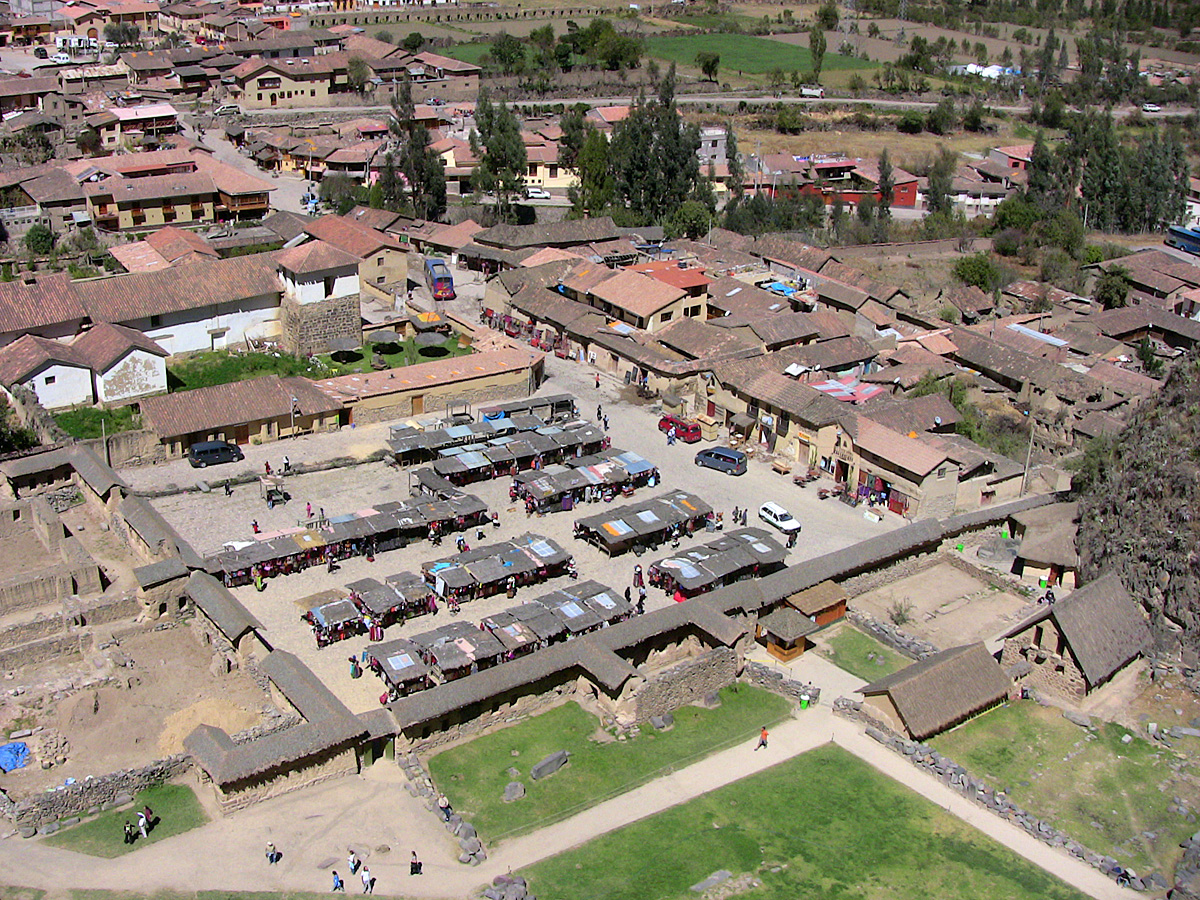
Click to enlarge
In the hills above the town are the terraces of Ollantaytambo and a massive Sun Temple. Down below, in the part of the city that is still lived in, was the Urban sector. Laid out in a typical Incan grid, this is the only place in Peru where one can still see people living in buildings that were used as homes in Incan times. The narrow streets still have their water channels and water still flows in them, although not while we were there. For some reason that even our guide didn't know, they were not flowing that day.
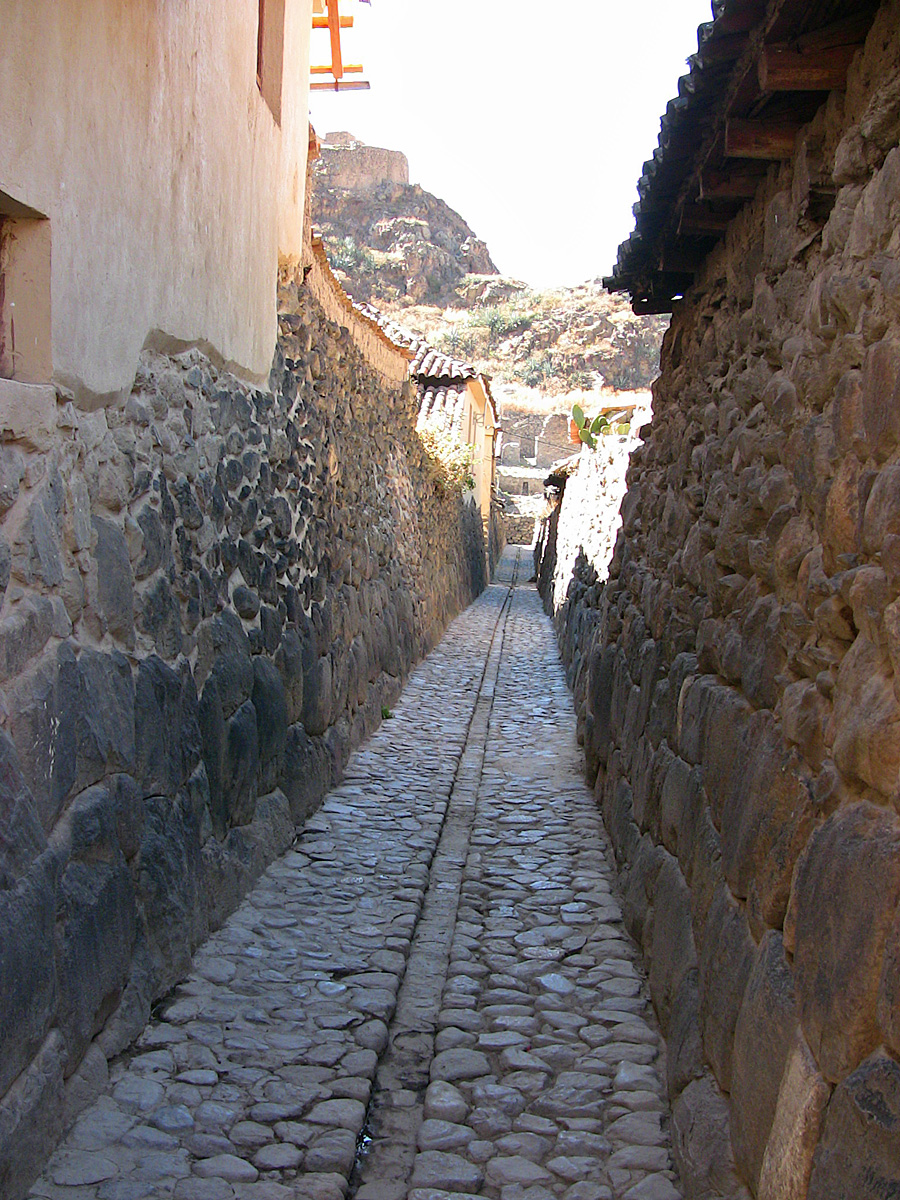
Click to enlarge
Our first stop was to a historic Inca house down one of these narrow Inca streets. We headed down the street aways from the plaza and, as always were mobbed by vendors, mostly women and girls, selling their wares. I bought a knit cap with some llamas in the design and the distinctive Andean ear flaps.

Click to enlarge
As we got farther away from the plaza, and closer to the Inca house, the street got quieter until the only other non-tourist in it was a young girl in traditional costume headed to the plaza to pose for tourist photos. I thought the Inca street would make for a nice location for a photo of her and gave her a Sol to take a couple shots.
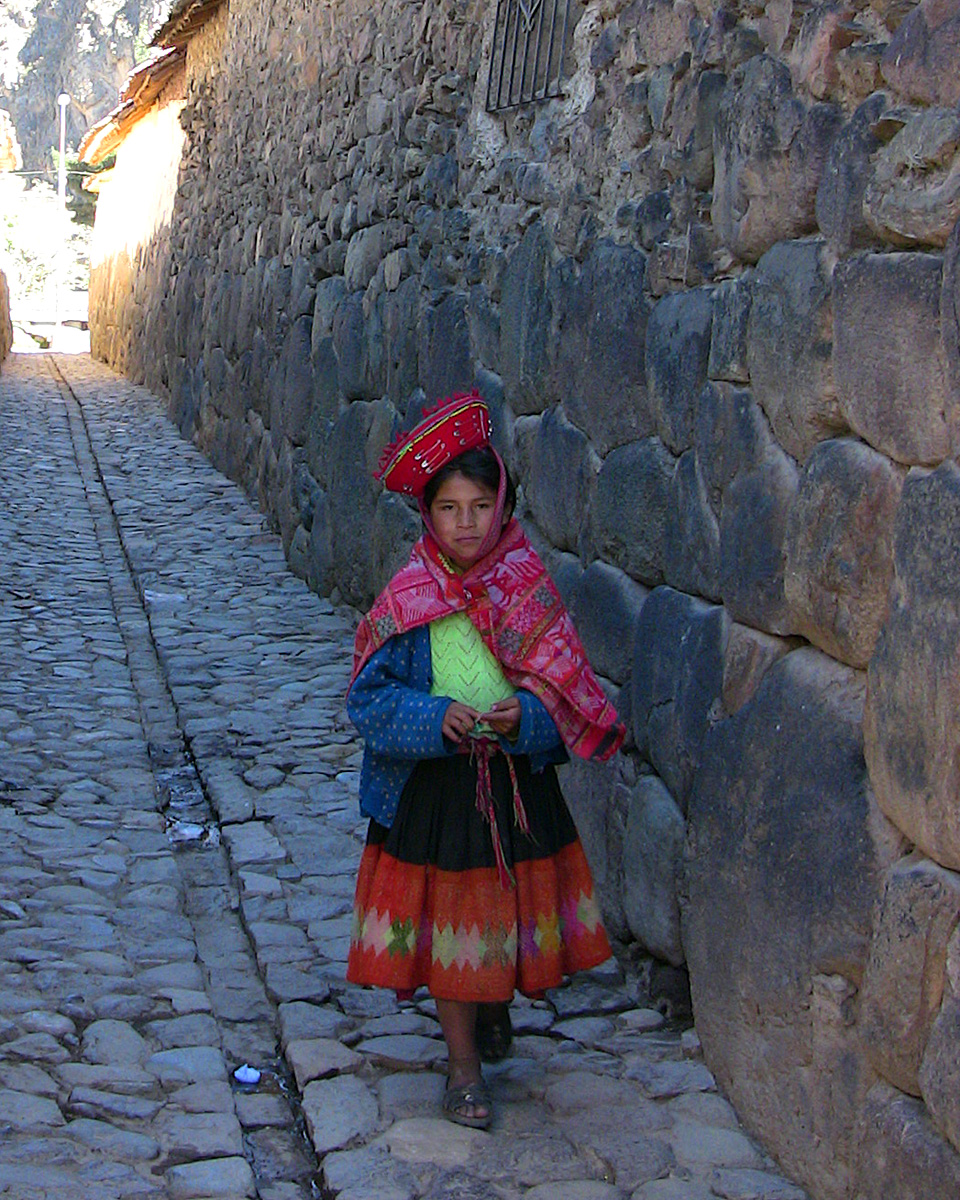
Click to enlarge
Her hat, like all the traditional hats, indicated where she was from. Like most Quecha people, she was quiet, somewhat shy, but very polite. It struck me, how different we must seem to her, as she does to us. What must she make of the throngs of tourists that flock to her town and get excited by her traditional clothing. "Does she go home at night and put on jeans and listen to her iPod", Claire wondered out loud? A good question.
As we would find out that night, during our private dinner in a Quechan home, while we as tourists marvel at the beauty of the landscape, the strong cultural tradition, and allow ourselves to wonder if their life, closer to the rhythms of the earth, is richer than ours. But the truth is their lives are hard, rough and full of struggle. While we as tourists dream of a more "spiritual" lifestyle they want what we have. Cars, TVs, better health care, decent food, a clean, safe environment, a better life for their children.
If we dream and wonder about their lives, they dream and wonder about ours.
I witness this all the time while I'm traveling through the American Southwest. Tourists come from all over the world to see Native Americans, fascinated by their culture and thinking that the Native cultures have the answer to our fast paced modern lives. They want to take an Indian name, do a sweat, and witness a ceremony. They dream of a life closer to the earth, in tune with nature. All the more ironic as our ancestors worked hard to create a life away from nature. Houses, roads, cars, etc. A life sheltered and protected from the elements. The history of most of human kind, especially western culture, has been to create a world of comfort and safety. Yet for some, when they attain that, they think that something is missing in their lives. Maybe it is. I guess each person needs to answer that for themselves.
I too have fallen into the myth of the indigenous life. During my time in Peru my senses were overwhelmed with the sights, sounds and smells of a unknown, exotic culture. But everyday I saw something that made me realize how lucky I am to have the life that my culture provides. Nevertheless, this did not diminish my respect and admiration for the people and culture I was visiting. Their culture has a richness and an authenticity that our modern, mass produced world lacks. But I still want my Starbucks...as it were.
When we reached or destination, the Inca house or wasi, this contrast of life styles was all brought into sharp focus as we laid eyes on their kitchen.
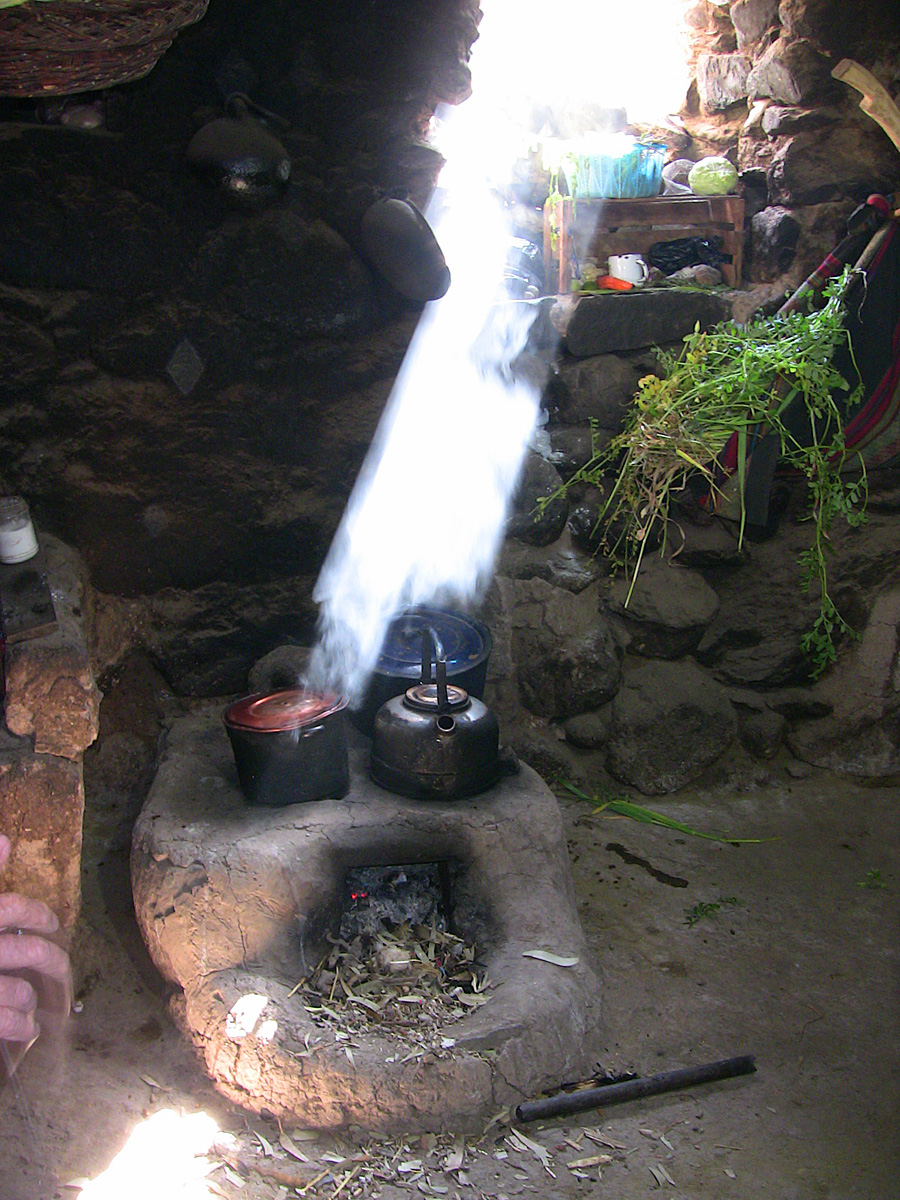
Click to enlarge
Just like the Chicha house, this home contained a very primitive kitchen. In fact more primitive. There wasn't even a small gas stove here. Just wood burning. Huddled up next to the right side was a brown and white Guinea Pig.
The house was part of a larger, traditional compound called a kancha. Most kanchas come in pairs that open onto a common courtyard or patio. The whole compound is walled off from the street, accessed through a small doorway.
The home we were visiting was just one large room. There was very little furniture. The bed was just a pile of blankets on a platform raised off the floor. The floor was the domain of guinea pigs, or cuy which wandered around, busily eating, having no knowledge of their fate. (Where as we humans do, of course...)
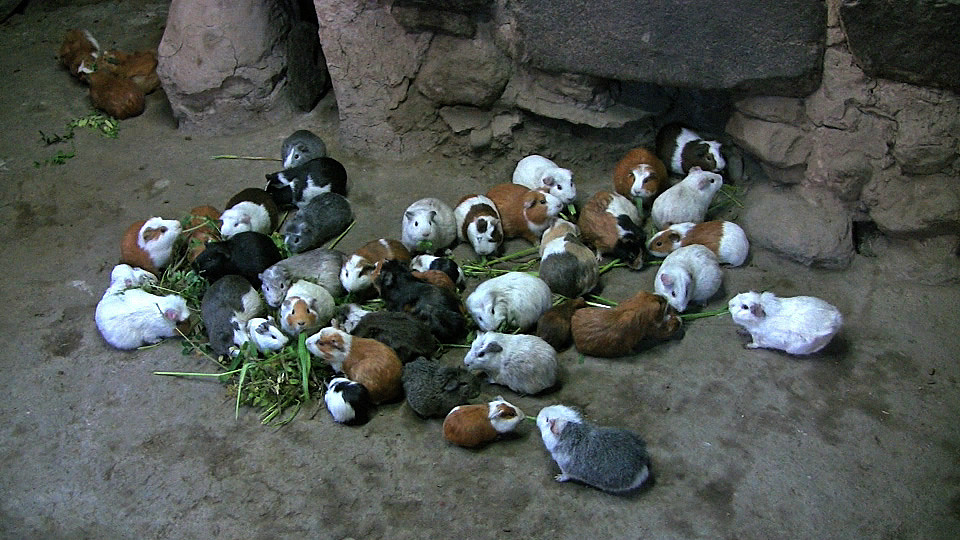
Laid out next to the wood stove were some common kitchen items and other things arranged for us to see. Different potatoes, corn a couch shell trumpet and other items.

Click to enlarge
Above this, set in a niche in the wall were two skulls from the ancestors of the home's current occupants.

Hanging from the roof beams in a bundle of other items was one of the most unusual things we saw in Peru. Unusual to us, anyway. This was the fetus of a Llama. In Prehispanic times the Inca sacrificed llamas to their Gods. These days their fetus are still used as an offering to the Mother Earth, Pachamama. They are buried under the foundation of a building before it goes up, for blessings of health, safety, happiness, wealth and fertility.

Click to enlarge
The wing of a condor hung on the west wall.
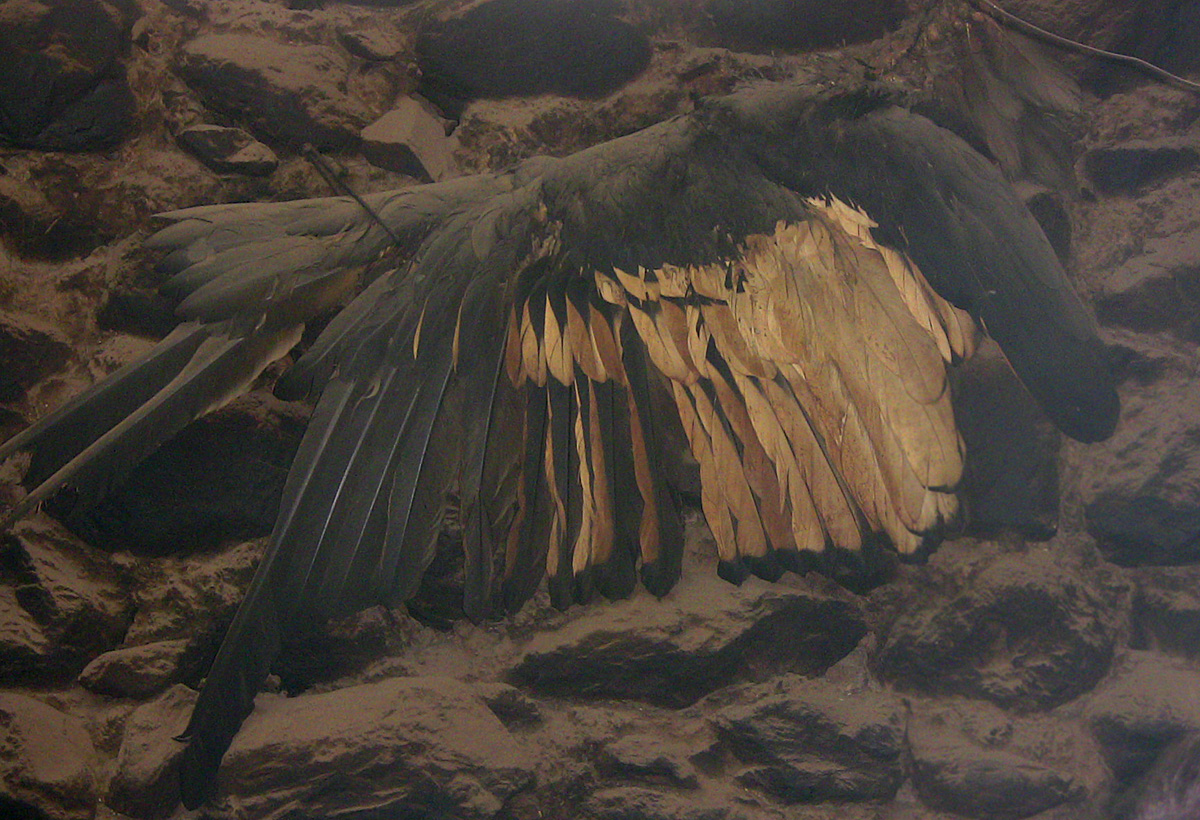
Click to enlarge
To end this post I'm going to let our guide, Fredy, talk about some of the items in the house via an amazingly high quality video clip...
Next we'll take a look at the upper section of Ollantaytambo, with its towering terraces, double-jam doorways and Sun Temple.
All text, images and video © 2010 Scott August / Cedar Mesa Music. All rights reserved.
Previous Peru Journals
Part 1: "Journey to Peru"
Part 2: "Lost in Translation"
Part 3: "Flight of the (Silver) Condor"
Part 4: Inca Pisac
Part 5: The Pisac Market
Part 6: Corn Beer and River Rafting
Thursday, June 03, 2010
Another Path: Improvisation for Mojave Flute
Here is a video of a Mojave flute solo improvisation I gave at a bookstore last month.
The piece is called Another Path
© 2010 Cedar Mesa Music, BMI
The piece is called Another Path
© 2010 Cedar Mesa Music, BMI
Wednesday, May 26, 2010
Panorama Readers Award
The last time I talked about how to run an Artist Owned record label I talked about tracking sales and managing your inventory. I also talked about the app that I use to do that: Panorama by Provue Development. You can read about that here.
I found out today that Panorama is up for an Ars Design Award. Not only that but they are also allowing the public to vote. Like Cedar Mesa Music, Provue is a little company and needs our support. If you are a fan of my music go over to the Ars Design Award webpage and vote for Panorama. You don't have to register or sign up for anything. Plus you can vote once a day, per computer till May 30th, 2010.
Thanks!
I found out today that Panorama is up for an Ars Design Award. Not only that but they are also allowing the public to vote. Like Cedar Mesa Music, Provue is a little company and needs our support. If you are a fan of my music go over to the Ars Design Award webpage and vote for Panorama. You don't have to register or sign up for anything. Plus you can vote once a day, per computer till May 30th, 2010.
Thanks!
Thursday, April 29, 2010
Musical Echoes 2010, Day 1
I just got back from Musical Echoes in Florida a couple days ago. This was my first time there and I had a wonderful time. This trip included a lot of "firsts" for me and I thought I'd share some of the weekend with everyone.
As always, the days leading up to a trip to perform are always busy. This is more so when I'm not driving as I have to figure out how to get all my stuff to the location. The week before I shipped product, forgetting to pack my Anasazi book. Then I had to borrow a better suitcase so my shirts and coats wouldn't get too wrinkled. They always do anyway.
The next morning when we arrived at the terminal the TSA line snaked back and forth in a landing above the ticket counter, out the door down to the next terminal and then doubled back on itself. I thought sure I was going to miss my flight. However after spending over an hour in the line I made it to the gate just as boarding started.
I had to stop at DFW, which was much easier to deal with than LAX even though I'd never been there before. They had a train that connects all the terminals like a lot of newer airports. From DFW I boarded a 50 seat jet and head to Ft. Walton Beach.
As I headed toward the baggage claim area there was my "ride", David waiting for me. David is one of the organizers and I liked him right away. A musician himself, he had a strong southern accent and welcomed me to "LA"
"LA?", I replied in confusion.
"Yeah, Lower Alabama, that's what we call it down here".
I felt right at home.
We drove by the park where the festival is held, right on the water of a channel behind a barrier island. I met the sound guy and some others. Everyone was really friendly. Then he dropped me off at my room, which was too nice for the likes of me, and said to call when I needed a ride in the morning. I grabbed a bite for dinner, read some of the book I brought and went to bed. It had been a long day.
The next morning I woke to clear, sunny skies. I grabbed some breakfast at a Waffle House (another first) and then David swung by to take me to the festival.
There I met Dave McCullen in person, we had only dealt online before (another first). Dave, for those of you that don't know, makes amazing PVC rim blown and oblique blown flutes. He has been doing so for a long time. Second perhaps to Michael Graham Allen. I have one of his PVC Hopi flutes. He doesn't sell flutes, but gives them to those lucky few. He works under the name Warrior Wind Flutes. While we were talking I was expressing how lame I felt since I hadn't shipped a blanket for my table. Dave said he could get one and took off. He returned about five minutes later with a really nice blue fleece with a "Native" design on it. When I asked who let him borrow it he replied "I bought it for you". I was so touched, but insisted that I pay him back. He took the money I gave him and promptly bought a copy of Radiant Sky from me! He later came by the both with a Ney and a Kaval. Several of us were lucky enough to get flutes by him. What a treat. I got a Ney and a Kaval and another Hopi flute and an oblique blown flute with a NAF tuning. The last two I can play, the Ney and Kaval, not yet.
Mark Holland had a booth near mine, Jeff Ball showed up later and set up next to me. Also there was Jonny Lipford and Michael Searching Bear. I'd met Jeff and Mark and Jonny before. Jeff I've been lucky to know since 2002 and Mark I met in 2007 I think. They are both great guys and as we all know great flute players. Jonny I meet at the last INAFA convention. He's really coming up with his career and I hoped to get a chance to talk to him sometime during the weekend.
During the day there was a flute competition and then the performing began. All this time the nice sunny sky was becoming darker and darker, the air turned cold and rain threaten to start. I took the stage at 6 PM and as I was playing I could see lightening to the west. It started to drizzle. The sound guy, Bob, told me to keep playing while they dismantled the lights in front of the stage and the speaker stacks. I slogged on as best I could as the lightening got closer, thunder started to clap, the rain increased, and the sound guys yelled back and forth as they lowered the lights in front of me. Finally the rain got so hard it was time to shut everything down. Even with all the commotion I felt lucky. At least I got to play. All of the evening performances were canceled. Once I stopped the brave few that were still in the audience rushed for cover and we all headed out.

Performing during the lightening, thunder and rain
Photo by Cynthia McDonald
The lightening storm was amazing. I don't think I've ever seen so much lightening in one storm. We don't get a lot in LA. A bunch of us went to dinner. Myself, Katy Owen, Deborah Peterson, Lynn Lipford, Michael Searching Bear and his band, and the 2nd place winner of the flute competition, Traci Conley Junge and her family, were just part of the group. While at dinner Katy told us that she'd been hit by lightening three times!
We all hoped for better weather the next day...
As always, the days leading up to a trip to perform are always busy. This is more so when I'm not driving as I have to figure out how to get all my stuff to the location. The week before I shipped product, forgetting to pack my Anasazi book. Then I had to borrow a better suitcase so my shirts and coats wouldn't get too wrinkled. They always do anyway.
The next morning when we arrived at the terminal the TSA line snaked back and forth in a landing above the ticket counter, out the door down to the next terminal and then doubled back on itself. I thought sure I was going to miss my flight. However after spending over an hour in the line I made it to the gate just as boarding started.
I had to stop at DFW, which was much easier to deal with than LAX even though I'd never been there before. They had a train that connects all the terminals like a lot of newer airports. From DFW I boarded a 50 seat jet and head to Ft. Walton Beach.
As I headed toward the baggage claim area there was my "ride", David waiting for me. David is one of the organizers and I liked him right away. A musician himself, he had a strong southern accent and welcomed me to "LA"
"LA?", I replied in confusion.
"Yeah, Lower Alabama, that's what we call it down here".
I felt right at home.
We drove by the park where the festival is held, right on the water of a channel behind a barrier island. I met the sound guy and some others. Everyone was really friendly. Then he dropped me off at my room, which was too nice for the likes of me, and said to call when I needed a ride in the morning. I grabbed a bite for dinner, read some of the book I brought and went to bed. It had been a long day.
The next morning I woke to clear, sunny skies. I grabbed some breakfast at a Waffle House (another first) and then David swung by to take me to the festival.
There I met Dave McCullen in person, we had only dealt online before (another first). Dave, for those of you that don't know, makes amazing PVC rim blown and oblique blown flutes. He has been doing so for a long time. Second perhaps to Michael Graham Allen. I have one of his PVC Hopi flutes. He doesn't sell flutes, but gives them to those lucky few. He works under the name Warrior Wind Flutes. While we were talking I was expressing how lame I felt since I hadn't shipped a blanket for my table. Dave said he could get one and took off. He returned about five minutes later with a really nice blue fleece with a "Native" design on it. When I asked who let him borrow it he replied "I bought it for you". I was so touched, but insisted that I pay him back. He took the money I gave him and promptly bought a copy of Radiant Sky from me! He later came by the both with a Ney and a Kaval. Several of us were lucky enough to get flutes by him. What a treat. I got a Ney and a Kaval and another Hopi flute and an oblique blown flute with a NAF tuning. The last two I can play, the Ney and Kaval, not yet.
Mark Holland had a booth near mine, Jeff Ball showed up later and set up next to me. Also there was Jonny Lipford and Michael Searching Bear. I'd met Jeff and Mark and Jonny before. Jeff I've been lucky to know since 2002 and Mark I met in 2007 I think. They are both great guys and as we all know great flute players. Jonny I meet at the last INAFA convention. He's really coming up with his career and I hoped to get a chance to talk to him sometime during the weekend.
During the day there was a flute competition and then the performing began. All this time the nice sunny sky was becoming darker and darker, the air turned cold and rain threaten to start. I took the stage at 6 PM and as I was playing I could see lightening to the west. It started to drizzle. The sound guy, Bob, told me to keep playing while they dismantled the lights in front of the stage and the speaker stacks. I slogged on as best I could as the lightening got closer, thunder started to clap, the rain increased, and the sound guys yelled back and forth as they lowered the lights in front of me. Finally the rain got so hard it was time to shut everything down. Even with all the commotion I felt lucky. At least I got to play. All of the evening performances were canceled. Once I stopped the brave few that were still in the audience rushed for cover and we all headed out.
Performing during the lightening, thunder and rain
Photo by Cynthia McDonald
The lightening storm was amazing. I don't think I've ever seen so much lightening in one storm. We don't get a lot in LA. A bunch of us went to dinner. Myself, Katy Owen, Deborah Peterson, Lynn Lipford, Michael Searching Bear and his band, and the 2nd place winner of the flute competition, Traci Conley Junge and her family, were just part of the group. While at dinner Katy told us that she'd been hit by lightening three times!
We all hoped for better weather the next day...
Wednesday, April 21, 2010
Anasazi Flute Duet Video
Here is a video of me playing both parts of an Anasazi flute duet.
This is is a G Anasazi by Earth Tone Flutes recorded live on March 12, 2010 in Orange County, CA. I recorded the first pass and then looped it back to play a second part against it. This was all done in real time using Digital Performer.
For more information about these flutes check out my articles. To learn how to play one purchase my Complete Guide to the Anasazi Flute
© Cedar Mesa Music. All rights reservered.
This is is a G Anasazi by Earth Tone Flutes recorded live on March 12, 2010 in Orange County, CA. I recorded the first pass and then looped it back to play a second part against it. This was all done in real time using Digital Performer.
For more information about these flutes check out my articles. To learn how to play one purchase my Complete Guide to the Anasazi Flute
© Cedar Mesa Music. All rights reservered.
Subscribe to:
Posts (Atom)